


Chapter 9 – "Real Estate and Mortgages"
Description
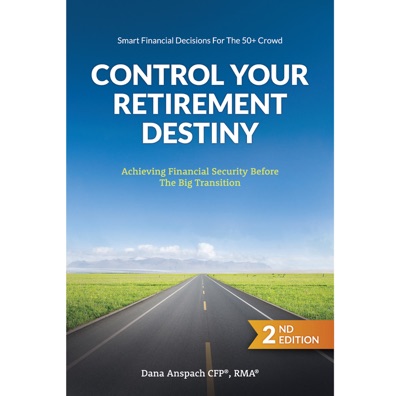
In this episode, podcast host and author of “Control Your Retirement Destiny”, Dana Anspach, covers Chapter 9 of the 2nd edition of the book titled, “Real Estate and Mortgages.”
If you want to learn even more than what there is time to cover in the podcast series, you can find the book “Control Your Retirement Destiny” on Amazon.
Or, if you are looking for a customized plan for your retirement, visit us at sensiblemoney.com to see how we can help.
Chapter 9 – Podcast Script
Hi, this is Dana Anspach. I’m the founder and CEO of Sensible Money, a fee-only financial planning firm. I’m also the author of Control Your Retirement Destiny, a book that covers the vast array of decisions you need to make as you plan for a transition into retirement.
This podcast covers the material in Chapter 9, on real estate and mortgages.
If you like what you hear today, go to Amazon and search for Control Your Retirement Destiny. And, if you are looking for a customized plan, visit sensiblemoney.com to see how we can help.
—————
It was about 2010, and I was having a conversation with a woman who I considered to be successful and intelligent. Suddenly she says, “Well, stocks are a much better investment than real estate, right? You’re a financial planner, so isn’t that what you tell your clients?”
I was speechless.
A good planner plans. Planning encompasses all aspects of one’s financial life, including real estate and mortgages. It would be irresponsible for a financial planner to make a statement such as “stocks are better than real estate.”
Many financially independent people that I know accumulated their wealth through real estate. On the flip side, many people I know experienced bankruptcy and foreclosure by stretching their real estate investments TOO FAR. Real estate can be a profitable investment if you know what you are doing, and a disaster if you don’t.
When nearing retirement, all aspects of your financial situation need to align toward a common goal: generating a reliable source of cash flow. That means real estate and mortgages need to be evaluated just as carefully as other items on your balance sheet.
In this podcast, I’m gonna start by talking about your home and mortgage, and address one of the most common questions, which is, “Should you pay off your mortgage before retirement?” Then we’ll talk about home equity lines of credit and how to use them in retirement. And we’ll move on to discussing investment properties, and the last thing we’ll cover will be reverse mortgages.
First, let’s talk about your home. Is it an investment? Meaning is it something you hope to make money on? Or is it a lifestyle choice - something you purchase for comfort and pleasure? Everyone has their own opinion on this. For most people, the answer lies somewhere between these two extremes.
I rarely see people buy a personal residence solely because they think they can make money on it. Most of the time other factors like location, the type of neighborhood, and other personal lifestyle preferences have a big impact on a home purchase.
Yet, when discussions about retirement start to happen, at that point, people often take a fresh look at their home as an asset.
For many of you, a portion of the value of your home will need to become a part of your retirement income plan.
If you know this ahead of time, you can put more thought into your next home purchase, how you finance it, and figure out how it fits into your plan.
When I talk about fitting a home into your plan, I am not talking only about downsizing. There are other creative ways to think about your home and where you live.
For example, you can choose a home that has ample access to public transportation, so you would not need a car on a daily basis. With services like Uber and Lyft, this option can work well today and result in a net savings over the cost of auto ownership.
You can make your home as energy-efficient as possible, and make sure it has a garden or other area conducive to growing your own food.
Another option is to rent a room in your home, or buy a home that has space that can be converted into a rental. For a large portion of my adult life I had roommates. Financially, it helped cover the mortgage. For me, of even more importance, it provided me with a built-in pet sitter. I’m a dog lover. When I traveled for work or to see family, I never had to kennel my pups. This saved me quite a bit of money over the years.
And today, online options like AirBnB or VRBO.com (which stands for “vacation rentals by owner”) allow you to rent out your home, or a room in it, on a temporary basis to travelers.
Or maybe you’re thinking about moving once you’re retired. Look for states that are tax-friendly for retirees. A simple Google search on “tax friendly states for retirees” will lead you to a few great articles that show you which states might be best.
There are many creative ways your home can contribute to your retirement plan.
One of the most common questions about a home is whether you should pay off the mortgage before retirement. When I started in the financial planning business in 1995, we were trained to tell people that they could earn a higher rate of return by investing their money rather than paying extra on the mortgage. I was 23 years old and told people what I was trained to tell them.
Today, I don’t agree with that one-size-fits-all type of advice. I think most Americans are better off paying off their mortgage by the time they retire, but, not all.
The Center for Retirement Research at Boston College has done research on this topic and has an online paper available titled, “Should You Carry a Mortgage into Retirement?” In this paper, they also conclude that most retirees are more financially secure by paying off the mortgage before retirement. The research paper rejects the argument that households can earn a higher return in stocks or other risky assets. The paper addresses the practical consideration that folks trying to manage their investments for a higher return can make poor investment choices and easily mismanage their money. Cognitive decline is real, and older Americans also fall for scams. This is something to keep in mind. The money in a paid off home is safe.
Paying off the home can also be a way to trick yourself into saving more. Let me tell you about how this worked out for Jackie and Bob, who wanted to retire early.
Each time they came in to review their plan I would explain to them that they needed to save more in order to make early retirement happen.
A year later, they would come back, and their savings had not increased. They had the income to save more, but it wasn’t happening.
Finally, I decided to try a different approach. I suggested they make extra payments on their mortgage and told them as soon as their mortgage was paid off, they could retire.
Suddenly they began making progress! Seeing the mortgage balance go down was tangible. They could measure their progress toward a goal that they wanted to achieve. Accumulating money in their investment accounts where the value would fluctuate from month to month just didn’t have the same effect for them. Soon their mortgage was paid off, and today, they are happily retired.
Now, this worked for Jackie and Bob, because they were already funding their retirement accounts, and still had extra money each month to apply to their mortgage.
Are there some groups of people who may NOT want to focus on paying down the mortgage? Yes, there are. There are four scenarios I see where it may NOT make sense to pay off the mortgage.
If you are ten years or more away from retirement and trying to decide whether to pay extra on the mortgage or put more in your 401k plan, the right answer for you may be different than the right answer for Jackie and Bob. For many high-income earners, funding extra into a tax-deductible plan like a 401k will result in a better outcome over ten years than paying extra on the mortgage.
If you are a high net worth individual, or a business owner who needs to focus on asset protection, then retaining debt may have some advantages in the event that you are sued. For high net worth folks, there is a great book called The Value of Debt, by Tom Anderson, that explains why higher net worth families may want to focus on retaining the right kind of debt rather than pay everything off.
If you are a savvy business person, for example, someone who invests in franchises, or private lending, and routinely expect returns higher than 10%, then maybe you don’t want to pay off your mortgage early.
If mortgage rates are super low, keeping the mortgage and investing elsewhere may make sense. When I originally wrote Control Your Retirement Destiny in 2012, mortgage rates were in the 2.5 – 3.5% range. I don’t recommend paying off the mortgage when the rate is that low. Once the mortgage rate goes north of 5%, then I think it makes sense to begin looking at ways to pay it down.
Now, if you don’t fit in one of these four categories, and you’re listening to this thinking you ought to run out and cash in an IRA to pay off the mortgage – wait! That is not what I am talking about.
There are big tax consequences to cashing in an IRA or retirement account. After factoring in taxes, it rarely makes sense to take a big chunk of money out of a retirement account to pay off a mortgage. On the other hand, what if you inherit money that is not an IRA? Or sell a business or other property and have cash? Then, it may make sense to use that cash to pay off the


 United States
